
Fashion Magazine Covers: Revealing and Concealing
I wanted to write more about Peter Leonard’s digital humanities research in the Vogue archive. His visual representations of continuity and change in Vogue during the 20th century are not only visually stunning, but also thought provoking.
In his article (http://www.thegogglesdonothing.com/archives/2013/10/vogue_cover_averages.shtml) he cross- references his observations about the magazine covers with tenure of editors and circulation figures. His analysis identifies patterns – 1940s-1950s cover analysis reveals the eclectic and diverse nature of illustrated covers produced by avant-garde artists and image-makers of that era, while the 1970s-1980s fall into what Leonard describes as a ‘visual rut’. These decades stick to a consistent composition of a closely framed model’s face, with a jaunty tilt.
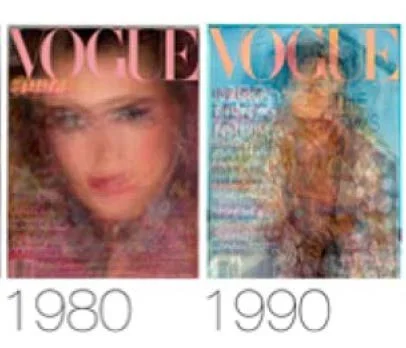
Detail from Peter Leonard’s Vogue Cover Averages digital humanities research project.
1980 depicts the ‘visual rut’ Vogue US covers had fallen into prior to Anna Wintour’s editorship, 1990 captures some of the changes she implemented.
Image courtesy of Peter Leonard (The goggles do nothing blog)
The cover of the magazine plays a significant role – it forms a promotional space for magazine contents, enticing potential readers to browse or make the purchase. The cover has a direct relationship to what is inside the magazine, both in terms of content and the business operations of Vogue and its production processes. However, the cover also forms the connective tissue between the external and the internal context of the magazine; it’s an intersection of influences emerging from within and without.
Vogue magazine has three significant external market contexts within which it functions – the business of magazines publishing, fashion and the preferences of the fashion consuming public and the creative cultural landscape. Anna Wintour stepped into the editor role at Vogue US in the late 1980s (her first issue was November 1988). One of her first moves was to make changes to the covers, in part to signal her new approach to editorial management; but her changes reflect an astute understanding of the changing external relations of Vogue magazine at that time.
Anna Wintour needed to make a fresh fashion statement for Vogue magazine to maintain its profile against its competition – newly launched Elle magazine and the thriving Harper’s Bazaar. Under her editorship, covers were composed to convey a new attitude to dressing by mixing high-low fashions (jeans with designer jackets, for example).
Her covers utilised a more youthful and energetic visual language – through choice of models, framing more of the figure, often in dynamic poses and by shooting the photos outside of the studio. They better reflected the mood of contemporary fashion at the time as well as connecting with fashion consumers and their approach to self-fashioning. In addition, Wintour bought celebrities to the cover of Vogue magazine. Madonna, Oprah, Gwynnie have all been featured (with a noted increase in sales for these issues – the Madonna cover is said to have lifted sales by 40%). Under Wintour’s direction, the celebrity theme has extended to super-star couples (Kimye, Cindy Crawford & Richard Gere); a change to Vogue covers tied to the changing cultural context – a culture dominated by celebrities.
I wanted to offer some additional framing for the beautiful composite covers developed by Peter Leonard’s research. And comparing the 1980s and 1990s covers I think the changes describe above make themselves felt. The cover of Vogue magazine is a fashion statement and rich site of analysis – operating as a point of intersection. Fashion media and communication has shifted towards online / onscreen platforms, with that, the landing page and digital feed offer a different proposition, changing the material and immaterial significance of the magazine cover – but that is a topic for another post.