
Fashion taste-making is still happening between the covers of Vogue
Vogue is a long-standing taste-making institution, with a reputation for drawing together a selection of the most fashionable people, places, brands and products between the covers of its monthly magazine.
It assembles a set of taste-making entities each month, offering a perspective on future fashionable taste. Joan Juliet Buck (editor Vogue Paris 1994-2001) described this process:
“We are making more than magazines, we are making the most addictive substances there is – the dream.”
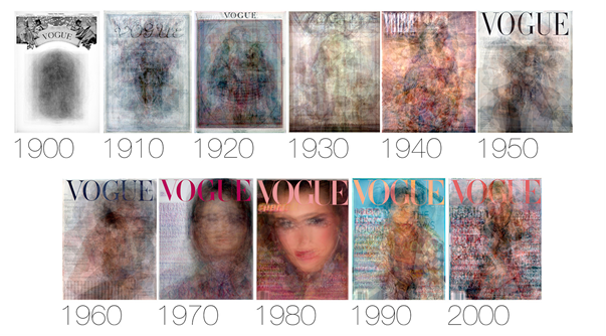
Vogue Cover Averages (A visualisation of continuity and change)
Image courtesy of Peter Leonard (The goggles do nothing blog)
http://www.thegogglesdonothing.com/archives/2013/10/vogue_cover_averages.shtml
In the mass-communication systems of 20th century, expert knowledge conveyed through monthly magazines was important and effective. However, the digital context of the 21st century enables instant access to fashion information, influences and influencers, allowing us to be as informed and up-to-date as the experts.
Yet Vogue’s endorsement still counts, it has successfully leveraged its reputation as a fashion authority to maintain its status in the contemporary networked fashion communication system.
On first glance at the monthly fashion magazine, little appears to have changed. Comparing Vogue 1967 with Vogue 2017, there are a few formatting differences maybe, more glossiness, a bit more fashion content and a different clutch of advertisers? However, if we use the magazine content to examine the relational networks that Vogue sits within, the differences between Vogue in the 20th century and Vogue in the 21st century begin to reveal themselves.
The network is a useful device on a couple of levels here. First, it represents the structural changes to media communications reshaping Vogue. Content that appears in print, morphs and flows across Pinterest, Youtube, Tumblr, Instagram, Facebook, Twitter and Snapchat, configured differently each time for a slightly different type of audience - reposts shares and retweets send Vogue content to places a magazine alone could never reach.
Vogue’s reputation as a tastemaker is also supported through its network of connections to “new” people, places, brands and products. In 2017, Vogue magazine extends its relational network through other fashion related activities such as fashion conferences and festivals, dining experiences, shopping events, design schools and travel opportunities. The pages reveal a (branded) social network of fashionable opportunities - people, places, products and experiences that enable Vogue to touch all aspects of our lives. Their fashion taste-making no longer happens simply through displays of connoisseurship and expert knowledge; it is immersive and experiential, it’s online and offline. The snapshot of Vogue’s relational network contained within its covers reflects the multi-faceted methods of influence and taste-making required in 21st century. Vogue has animated its taste-making, taking it off the page and bringing it to life.